Monday, April 8, 2013

Knowing Jesus in a New Way 2: Known in the Breaking of the Bread

Hi Godly Play Teachers!
Welcome to Knowing Jesus in a New Way 2: Known in the Breaking of the Bread, our lesson for April 14.
What a remarkable story from Luke 24:13-35. Two followers of Jesus (Cleopas and another unnamed) are walking from Jerusalem to Emmaus, talking about what had just happened to Jesus, and they meet a stranger on the road who asks them what they are discussing. The stranger is Jesus, but they don't recognize him. The two are speechless until Cleopas says, "Are you the only person who doesn't know?" Jesus then asks him to explain, and Cleopas says that they are talking about Jesus of Nazareth, "He was a prophet, powerful in word and deed before God and all the people. The chief priests and our rulers handed him over to be sentenced to death, and they crucified him;  but we had hoped that he was the one who was going to redeem Israel." Then he adds that some women went to the tomb and couldn't find his body and came back with stories of seeing angels who told them that he was alive.


Then the stranger calls them foolish and slow and says, "Did not the Messiah have to suffer these things before entering his glory?" He explains what was said by Moses and the prophets about Jesus in all the scriptures. 


As they near the village, the men ask the stranger (Jesus) to stay with them. As they settle down to eat together, Jesus takes the bread, says the blessing, breaks the bread and hands it to them, and suddenly they recognize who he is. At that moment, Jesus disappears from their sight. They say to each other, "Wasn't it like a fire burning in us when he talked to us on the road and explained the scriptures to us?" 
Of course they rush back to Jerusalem to tell the 11 disciples. 
How moving! The children are sure to be amazed with this scripture. 


Be sure to check out how the Godly Play script shares these verses. It's beautiful.


So, how do we help the children process the story?
If you are in a classroom where all the materials are near available to the children (if you aren't, I'd love to help change that--there's money for shelves for your circle) I hope you'll consider going along with the Godly Play script and letting the children gather items that help tell the story. It will be interesting to see the connections they make.


Here are some wondering questions for this lesson:
1. I wonder what your favorite part of today's story is.
2. I wonder how the two followers felt as they first started walking and talking, before they found the stranger.
3. The stranger talked to them about how the Jewish people had been trapped in so many ways and that prophets said a little child would lead the people out of being trapped. I wonder how Jesus helped the people from being trapped. 
4. Jesus said that someone would come to suffer and die so we might be really alive. I wonder what he meant by being really alive.
5. I wonder why Jesus' followers finally recognized him when he broke the bread and blessed it.
6. I wonder what the followers  might have said to each other after realizing it was Jesus, and then seeing Jesus disappear.
7. I wonder how Jesus helps us today from being trapped by our own mistakes.


Some Thoughts on Our Gift to God Time:
How can we help the children to re-live this story? Here are a few ideas:

This one is my favorite:
1. Why not literally walk through the story with the children? If the weather is good, I think it would be great to take a walk around the church, and as you walk, ask the children what the men must have said to each other, being so confused and scared and disappointed with what had happened. Help them imagine encountering a stranger. (You could even have one of the teachers play that role!)  You don't have to talk about the story the entire walk, but physically walking and talking about it to some degree helps the children imagine it and remember it.
When you return to the classroom, why not have bread and juice waiting and sit down and share what it must have been like to recognize Jesus in the breaking of the bread--and then have him vanish! I bet if the children walk through this experience, they won't forget it!


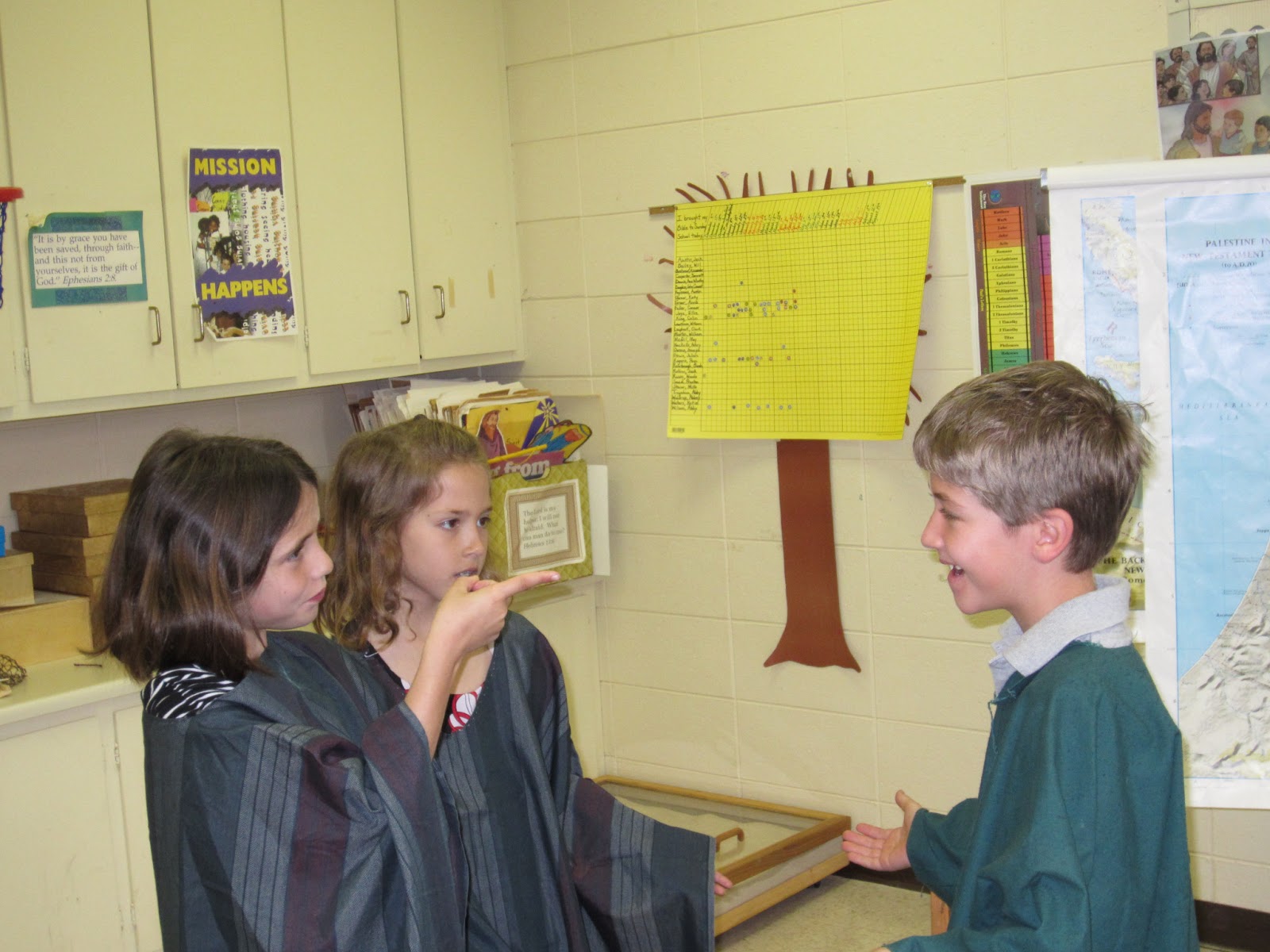
2. Act out the story in the classroom. Take photos!

3. Illustrate the segments of the different parts of the story: 
a)the two men walking, scared and confused,
b)the encounter with the stranger
c)what the stranger said, that a little child would come to lead the people and that someone would suffer and die so that we could really be alive
d) the meal at the inn
e) Jesus vanishing
f) the two followers rushing back to tell the disciples


4. Need other ideas? There's a whole bunch here.

Other ideas? Please share!
Thank you for all you do!
Love, Becky

Monday, April 1, 2013

Knowing Jesus in a New Way 1: Known in Absence

Hi Godly Play Teachers!
Welcome to Knowing Jesus in a New Way 1: Known in Absence, our lesson for April 7.
This week's story always gives me goosebumps-especially the moment when Jesus calls Mary's name and she recognizes him. It's hard to think of a story that would be more full of suspense and fear and joy, and the script for this Godly Play lesson does such a great job of sharing all of that with the children. I'm so glad that we don't have to cram all of the after-Easter stories into Easter Sunday! It's a luxury to be able to enjoy them and study them over several weeks.


The script is shared in the book that comes in the basket with your story tiles. This series is told much like the Easter series, with each lesson shared in a weekly tile, presented in sequence. The book suggests that after the story is shared, that you give the children time to find something among your Godly Play materials that helps further tell/illustrate the story. I hope that if you have the materials out in your room that you'll do that. I'll also include wondering questions for you for each week.


Here are the wondering questions for this week. Thank you so much for taking time to jot down responses so that we can share them with the parents.They have shared that they find it meaningful and enjoy feeling connected to what happens in class.


Wondering Questions:
1. I wonder what your favorite part of today's story is.
2. I wonder what the three women named Mary first felt when they saw that the tomb was empty.
3. I wonder what Mary thought when the person she thought was the gardener called her name and she realized it was Jesus.
4. I wonder what John and Peter hoped to find as they ran to the tomb, and what they said to the others when they found it empty. I wonder what they thought would happen next.
5. I wonder if there are ways we can learn about Jesus even though  he's not here with us. I wonder what those ways are.
6. I wonder what God is trying to teach us with this story about loving Jesus even when we're not with him.


Gift to God Response Time Ideas:
There are a couple different ways children can respond to the story: either by (1)retelling it through art with the ideas below, or (2) by exploring ways in which they can know Jesus in his physical absence.


(1) Retelling the story of the empty tomb through art.
 
Children may want to brainstorm how they might represent the empty tomb story with their own ideas. Could they make a cave with clay, and add some strips of linen to the inside, with a large stone rolled away? Could they build the tomb with Lego or Lincoln Logs (feel free to help yourselves to the materials in the game room.) Or make it out of paper plates?


Could they make the people in the story: the three Marys, Peter and John, Jesus as the gardener?  Could they act out the story for the class using the materials they made? If they choose to do this, please do take photos!

Or maybe they'd like to paint the story or draw it. You could also make the cave as shown here or here  
or here. 


Or if you're in the mood to cook, why make Resurrection Rolls? They turn out sort of like popovers-hollow in the middle like a cave. The recipe is here. You can use the oven in the parlor or make them ahead at home.


2) Exploring ways in which they can know Jesus in his physical absence
Hopefully the children will share ideas during the wondering questions of how they can know Jesus even though he's not physically with us. They could work together to illustrate a mural / list of these ways, including reading the Bible stories about Jesus, (ask the children to look through the Gospels and pick out their favorite ones and illustrate those,) listening to teachers and preaching about Jesus, praying, looking at artwork that artists have done about Jesus and his life, studying the Jewish faith that Jesus came from, learning about Jesus from the ways other Christians treat people. (This is a tricky one, isn't it?)
 I'm sure the children will think of even more ideas of ways to learn about Jesus.


Children could also explore how they "see" Jesus in other people. How can we act to make sure people see Jesus in us? This could be a great subject for a mural or class project.


I hope these ideas help!
Love, Becky
   

Monday, March 25, 2013

Faces of Easter VII: Celebrating the Risen Christ

Hi Godly Play Teachers! Happy Easter, in advance!
Welcome to Faces of Easter VII: Celebrating the Risen Christ, our lesson for Easter Sunday, March 31.
What a beautiful and important lesson we have this Sunday: the crucifixion and resurrection of Jesus! I love how Godly Play presents this lesson, reminding children that the crucifixion side of the story cannot be pulled apart from the resurrection part, and that which looks like an ending is actually a beautiful beginning.

There are wondering questions at the end of the lesson with the script. I'll have those in your room as well.

Don't forget to allow time for your children to celebrate the resurrection by visiting the cross on the courtyard outside the sanctuary, where each child will have an opportunity to add a flower or two to the cross. Maybe the younger children can go at the beginning of Sunday school, and y'all can stagger your visits so everyone has time to enjoy the cross. If you like, you could even take the kids to the labyrinth, with instructions for them to pray their own Easter prayer as they walk it. If the kids have plenty of direction as to what they're supposed to do (and if the weather is good) it might be a meaningful part of the morning!

We will have snacks in the game room before Sunday school, but you might want to share a special Easter snack with your kids (Hot cross buns or something Easter-y.) Just give me a clean receipt and I can make sure you're reimbursed. Easter is definitely something that deserves a party!

The children may have their own ideas about how they'd like to explore the story and celebrate it through art. It would be wonderful if they wanted to work together as a class to make a gift to God. Maybe a mural of the stone rolled away, or of the two sides of this week's story tile?

Here are some other ideas to add to your own:
Check out the stained glass cross example and directions here.

Make a plastic canvas cross here.

See a Resurrection cracked egg here.

All ages, from the youngest to the oldest would enjoy making a butterfly from a coffee filter as shown here. Discussion of how a caterpillar becomes a butterfly is a great lead in to talk about the transformation of Jesus. If you choose to do this and the kids have a chance to talk about what is alike/ different about the transformations, I'd love to hear the kids' comments. Jot them down if you have a chance.

Thanks y'all!
Much love, Becky

Monday, March 18, 2013

Faces of Easter VI: Remembering Jesus At the Last Supper

Hi Godly Play Teachers!
Welcome to Faces of Easter VI: Remembering Jesus At the Last Supper, our lesson for March 24.
:
What a whirlwind of a story this week's lesson is! So much happens, and all of it so very important: Jesus riding into Jerusalem on a borrowed donkey, greeted with palms waving, Jesus teaching in the temple and sharing the parable of the widow's offering, the temple guards' plan to take him on Thursday, the last supper in the upper room, Jesus praying in the Garden of Gethsemane, Judas' kiss of betrayal and Jesus' arrest. What an honor, to be able to share this with the children and help them process it.

This is a perfect week to let the children respond to the story by gathering things from the Godly Play materials in the room that they feel help tell the story. I hope you'll be able to jot these down for me, along with their thinking on this, so that I can share it with the parents. I'll also have the following wondering questions for you in case that works better for your class, or if you have time to do both:

Wondering Questions:
1. I wonder what part of the story is your favorite.

2. I wonder what part of the story is the most important.

3.In the parable Jesus taught in the temple about the old woman's offering, I wonder who really gave the most, the old woman or the rich man.

4. When Jesus had the supper with the disciples and broke the bread and shared the wine, I wonder what they thought it meant.

5. I wonder how the disciples felt when the guards took Jesus away.

6. The Bible says that the disciples ran away. I wonder what thoughts were going through their minds.

7. I wonder what thoughts were going through the mind of Jesus when the disciples ran away.

Give A Gift To God Time
Here are some ideas to add to your own:
1. Retell the story in sections. The story can be divided into scenes, with children working on different ones in pairs or individually. These can be hung together in your classroom if you like. Scenes would include the entrance of Jesus into Jerusalem, Jesus teaching in the temple, an illustration of the parable of the widow's offering, the Last Supper, Jesus praying in the garden, Jesus' arrest.

2. Make more ornaments for your Jesus (Easter) tree. Children could make donkeys or palm branches, representations of the widow's offering, bread or chalices of wine, praying hands or a praying Jesus, or bags of money, representing the 30 pieces of silver Judas was paid to betray Jesus. There are some ideas here and here.

3. Palm art. Here are directions for palm crosses for older children. You can use green ribbon too.

4. See more ideas of Palm Sunday crafts here.

Enjoy! I hope you have a very meaningful Sunday!

Monday, March 11, 2013

Faces of Easter 5: Remembering Jesus Healing and Sharing Parables

Hi Godly Play Teachers!
Welcome to Faces of Easter V: Remembering Jesus Healing and Sharing Parables, our lesson for March 17.
As we get ready for Easter this week, we remember the work Jesus did as he traveled around, healing people and sharing parables. It's a great chance to make clear to our children that being with people of all kinds, loving them, healing them of their physical and emotional wounds, and sharing truth through stories was the work that God sent Jesus to do--and still sends Jesus to do today. I look forward to hearing from the children ways that they can be like Jesus: how they can show their love for others, heal people who are hurting, and share God's truth with others.


You may want to share more detail in this week's lesson than what is written in the script. Because we are retelling all the parts of the Jesus story, sharing every tile that we've shared so far during Lent, the writer keeps the script very brief. As for me, I'd rather give very short summaries of the tiles shared in the previous weeks and spend a bigger chunk of time in the circle sharing the healing story and an example of a parable.


I've fleshed out the script for this purpose with a more detailed telling of Jesus healing the blind man and Jesus telling the Parable of the Friend at Night and will send you my version by email this week. Feel free to use it if you like.


If you haven't yet given each child an opportunity at the end of the circle time to gather something from the Godly Play materials that is related to this week's story and to share the relation that he/she sees, this week is the perfect opportunity to try it. Even if you also use the wondering questions, it could be an interesting and valuable part of the lesson. If you do, try to have an adult jot down their thoughts and ideas so that we can share them in the newsletter.


Since there are no wondering questions listed with the script, I'll have the ones below ready in your rooms. Thanks so much for taking time to document their responses. Having a peek into their thoughts and ideas is such a gift to the parents--and to the rest of us!


Wondering Questions:

1. I wonder what was your favorite part of today's story.
2. In the healing part of our story, wonder how the blind man felt and what he thought when Jesus first took him by the hand.
3. Jesus put his spit on the man's eyes, and the man could see, but not well. Then Jesus put his hands on his eyes again and his sight was perfect. I wonder why it took Jesus two times. 
I wonder what this might teach us about helping people.
4. We can't heal people's eyes by touching them, but I wonder how we can help people with their hurt bodies and hurt feelings.
5. We shared the story Jesus told called the Parable of the Friend at Night. In that story, I wonder who the friend is who has gone to bed. 
I wonder who you are in the story. 
I wonder what Jesus wanted us to know about praying.
6. We talked about the fact that Jesus' work was to come close to people, especially the people no one else wanted to come close to. If Jesus came to do this today, I wonder what kind of people Jesus would want to spend time with.


Gift to God Time

There are many different directions the children can go in responding to this week's time together. They could focus on retelling the healing story or the parable or both. Or they could extend this lesson by focusing on how we as Christians can participate in the healing of others and in telling truth and sharing God's message.

Retelling today's story:

1. Children could make 2 dimensional or 3 dimensional representations of the healing story or the parable story through drawing or painting it, making a mural, creating the scene in a diorama, making clay figures to act out the story, etc.


2. Children could work in a group or individually collecting healing stories of Jesus or parables Jesus told. How long a list could they make? Could you work together, giving groups of kids different gospels to scan, making a list on a piece of butcher paper? Maybe they could illustrate the list with a simple drawing beside each title. The Bibles in our Sunday school rooms have headings of each parable and healing story, making them easy to find. Do all the gospels tell the same stories? This would be good to investigate.


3. Children could be given the option of examining other parable stories in the parable boxes and retelling them to a partner. They might have to look these up in the Bible to make sure they remember the stories. We'd just need to be sure that they're careful to keep all the materials together and separate from each other.


4. Children could act out the story of healing!


5. The children could even make a mini-booklet of parables, with one on each page and a simple illustration.


6. Children could make ornaments for our Jesus tree from the different healing and parable stories. How about a set of eyes for this week? Or a door from the parable? Or items from other parables and healing stories. There are some interesting ones here.


How we can help heal others:

7. Children could make cards to help heal those who are sick or lonely. I'd be glad to pass these on to the ministers when they visit. When we've done this before we've had a great response. Cards really do make a difference!


Do you have other ideas to share? Please describe them in the comments!
Thanks for all you do!
Love, Becky

Tuesday, March 5, 2013

Faces of Easter IV: Remembering Christ's Desert Experience

Hi Godly Play Teachers!
Welcome to Faces of Easter IV: Remembering Christ's Desert Experience, our lesson for March 10.
As we get ready for Easter this week, we remember Jesus' temptation in the wilderness, described in Matthew 4: 1-11. It's good to remember that this event happened right after Jesus' baptism, before he could begin his work. Or maybe being tempted--and letting us see that even he was tempted--was part of his work!


As we all know (and have lived!) children have plenty of experience with temptation. Thankfully they have this sacred story to refer to, both now and as they get older. Temptation never goes away in life so it's a great lesson for all of us.


Since there are no wondering questions listed with the script, I'll have these ready in your rooms. Thanks so much for taking time to document their responses. Having a peek into their thoughts and ideas is such a gift to the parents--and to the rest of us!


Wondering Questions:
1. I wonder what is your favorite part of today's story.

2. I wonder what it felt like to be so hungry and to be reminded that if he wanted to, he could turn the stones into bread.

3. Jesus responded, "To be a real human being, we need more than just bread to eat. I wonder what he meant. I wonder what he thought we needed.

4. When Jesus found himself on top of the Temple, I wonder how it felt to imagine himself falling and having the angels save him. I wonder if people had seen him do that, what they might have thought about him.

5. I wonder how it felt to be tempted to easily become the king of all the kingdoms.

6. I wonder why Jesus needed to go through all of these temptations before he started working with people.


Now, some ideas to add to your own to serve as springboards for the children's response time:
Focus on retelling the story itself:
1. Children could draw the three separate scenes. They could do this individually, on a large paper, folded in thirds. Or they could do this as a class, on a large mural on butcher paper. They could make captions, explaining each scene.

2. They could show the desert scene with sand art, using glue and colored sand, as shown here.

3. They could pick one scene to draw (or all three) and paint the drawing with watercolors.

Focus on the idea of temptation and how God can help us deal with it.
4. On one side of a drawing or collage of magazine pictures, children could illustrate the different temptations they face at school or at home or at church or sports. (Cheating, disobeying parents, being hurtful to others, eating things that aren't good for them, etc).  On the other side they could show how they resist temptation by asking God for help. Or they could put on that side a verse of scripture or "What would Jesus do?"  Some scripture that might be appropriate might include:


James 1:12 Blessed is anyone who endures temptation. Such a one has stood the test and will receive the crown of life that the Lord* has promised to those who love him.

Psalm 62:8 Trust in him at all times, O people; pour out your heart before him.

Proverbs 3:5 Trust in the Lord with all your heart,and do not rely on your own insight. 

Isaiah 12:2 Surely God is my salvation; I will trust, and will not be afraid, for the Lord God * is my strength and my might; he has become my salvation.


5. Children could make a What Would Jesus Do bracelet with letter beads and twine, tying knots between each bead to make them stay in place.


6. Children could make ornaments for the Jesus/Easter tree in their Sunday school room. For today's lesson, this might include hot gluing stones to thread to hang, or ornaments of scripture from this lesson.


7. Children could make a banner from felt or fun foam on What Would Jesus Do?


I hope this helps! Thank you for all you do!

Monday, February 25, 2013

Faces of Easter III: Remembering Christ's Baptism and Blessing

Hi Godly Play Teachers!
Welcome to Faces of Easter III: Remembering Christ's Baptism and Blessing, our lesson for March 3.

As we get ready for Easter this week, we remember and celebrate Christ's baptism and blessing from God. How good it is to remember that Jesus chose to be baptized before he started his work, to mark the beginning of his adult journey toward the cross by getting in line with us, teaching us what to do. It reminds us how meaningful it is to begin our own discipleship by leaning into the darkness of the water, letting God cleanse us, allowing our old selves to die and be buried, and then get up, dry off, and start life marked and blessed officially as God's own.

There are so many ways we can go with this lesson. We must focus on the story itself, of course, but we can also give thought to examining the concept of the trinity, recognizing that this moment in Jesus' life is a beautiful interaction of the father, son, and the holy spirit.

At the end of the storytelling time you could  ask the children to gather items to put by the baptism tile, or you could use wondering questions to help them process the story. Here are the ones I'll have in your rooms:

1. I wonder what your favorite part of this story is.

2. I wonder what you already know about John the Baptist.

3. I wonder how John the Baptist might have felt when Jesus asked him to baptize him.

4. I wonder why Jesus wanted to be baptized, even though he was God's son?

5. I wonder what people thought when they saw the holy spirit come down toward Jesus. I wonder what they thought when they heard God's voice say, "This is my beloved son, with whom I am well pleased."

6. I wonder how it might feel to be baptized.

7. God and the holy spirit gave Jesus a blessing. I wonder what a blessing is. I wonder if you've ever been given a blessing and how that felt. I wonder if you've ever given anyone else a blessing.

Here are some ideas that might serve as springboards for the children's own creations:

Retelling the story:
1.  Have a small Jesus figure, a small John figure, and a pool (a large bowl of water) and let the children take turns at one table retelling the story and acting it out with the figures. We have a huge amount of clothespins that make great people figures.

2.  Let the children make their own Jesus and John figures (clothespins again?) and their own pool (plastic bowls or recycled containers like Cool Whip size-there may be some in the resource room. If not, you could even use a Solo cup, cut shorter.)

3. I remember a teacher from my own childhood having us clean dirty pennies with water and vinegar, talking about how our sins are washed away in baptism. I'm not sure how I feel about this.  If I did that today I would want to add that even after our baptism is done, we still have to ask God daily to forgive us of the mistakes we make.

4. Make a snack to celebrate this special event in Jesus' life.
You could make edible bugs to dip in honey as done here, or make trinity muffins as described here.

An edible locust! (See the antennae?)
5. Make more ornaments for your Jesus tree.
A. You could always make doves, as shown here or here (I know it's an owl, but you could make it into a dove,)  or here (I love that one.) Or pick up some feathers at the craft store and let the kids think themselves how to make it from the feathers and other materials you have on hand.

B. Another ornament idea is to make a Chrismon-type ornament that celebrates his baptism in particular as shown here (scroll down and see the scallop one.) Or why not use real scallop shells from a craft store and make your own like the one in the link. The kids could hot glue a ribbon to it and figure out how to represent the three drops of water shown in the chrismon--or not! They could put a dove with the shell, or make it however they like!


C. There's a pretty one out of felt here. Kids could copy it or even better, design their own!
http://www.mssscrafts.com/newtestament/baptism.htm

Examining the Concept of the Trinity.
1. Since we're almost at St. Patrick's Day, it might be a good time to look at the 3 leaved shamrock as a symbol of the trinity. Here's an ornament the kids could make out of fun foam here. And there are plenty of other ideas here. Be sure to scroll down to see all the examples.

Enjoy!
And don't forget to take photos! My camera is in the drawer of the table by the door to the Activity Room. :)